Why hiding your prices on your website is killing your conversion rate

This situation is probably familiar to you: you need a certain product or service and after a round of googling you found a website of a company that sells this product or service.
Before delving further into this, of course you want to know if the solution you've found fits your budget at all. But nowhere on the site are prices to be found. You only see a form where you can enter your information to "request a price quote." Frustrated, you click the website away and continue your search for a website that does list prices.
Recognizable? You're certainly not the only one annoyed by the lack of pricing information.
Yet many companies deliberately choose to hide prices on their website. They think this will help generate more leads, when in reality they are scaring away potential customers. If you have a business website, chances are you too are not transparent about your prices.
It may feel logical: When interested prospects fill out your contact form to receive a price quote, you can quickly respond and start the conversation. But as someone who also regularly sits on the ánother side, you also know it doesn't work that way.
As a co-founder/co-owner of Buzzlytics and certified Endless Customers (formerly They Ask, You Answer) coach,I regularly deal with companies that are excited about disclosing their prices on their website. At the same time, I have seen companies that did dare to do so see their conversion rates increase dramatically.
In this article, I explain why hiding prices on your website has an immediate negative effect on your conversion rate and how you can reverse it. You'll learn the psychology behind your potential customers' buying behavior, why the most common excuses for hiding prices are wrong, and what levels of price transparency there are. After reading this article, you'll know exactly how to become incrementally more transparent about prices and the impact this will have on your leads and sales.
This article is based on an episode of the StoryBrand podcast with Marcus Sheridan, author of Endless Customers. StoryBrand Netherlands is the sister company of Buzzlytics. Watch the interview below. Prefer to listen? Find the link to this episode on your favorite podcast platform on the StoryBrand website.
When a potential customer visits your website, one of the first questions that goes through their mind is, "Can I afford this?"
3 reasons why prices on your website are necessary
The first thing buyers want to know: "Can I afford this?"
When a potential customer visits your website, one of the first questions that goes through their mind is, "Can I afford this?" Or in the words of Marcus Sheridan, "Am I in the game at all?"
This question is crucial early in the buyer's journey. Before people are willing to delve into your offering, they want to know if they can afford it. It's a natural filter they use to determine whether it makes sense to continue their research.
When your website doesn't answer this fundamental question, you create unnecessary friction in the buying process. It's like forcing a potential customer to embark on an extensive scavenger hunt before he knows whether the treasure at the end is within his reach.
Buyers want to be sufficiently informed, comfortable and confident in their decision before they contact them.
The modern buyer wants control over the buying process
Furthermore, the way people buy has changed dramatically.
Two key statistics underscore this:
- The typical buyer has already completed more than 80% of the buyer's journey before contacting sales.
- 75% of all buyers say they prefer a "seller-free" buying experience.
This doesn't mean people hate salespeople. It means they want to stay in control of their buying process and contact them only when they are ready. They want to be sufficiently informed first, feel comfortable and confident in their decision.
If you force your website visitors to contact you to get basic pricing information, you go directly against this need for control. You're forcing them to engage in conversation faster than they want, which deters many potential customers.
AI tools don't show you
But there's another reason to show prices on your website. And that one has to do with AI tools.
Suppose your customer searches an AI tool like ChatGPT, Gemini or Perplexity for information about the cost of your product or service, specifying a budget. As the example below shows, your page will not show up in the results returned by ChatGPT if it does not include pricing information.
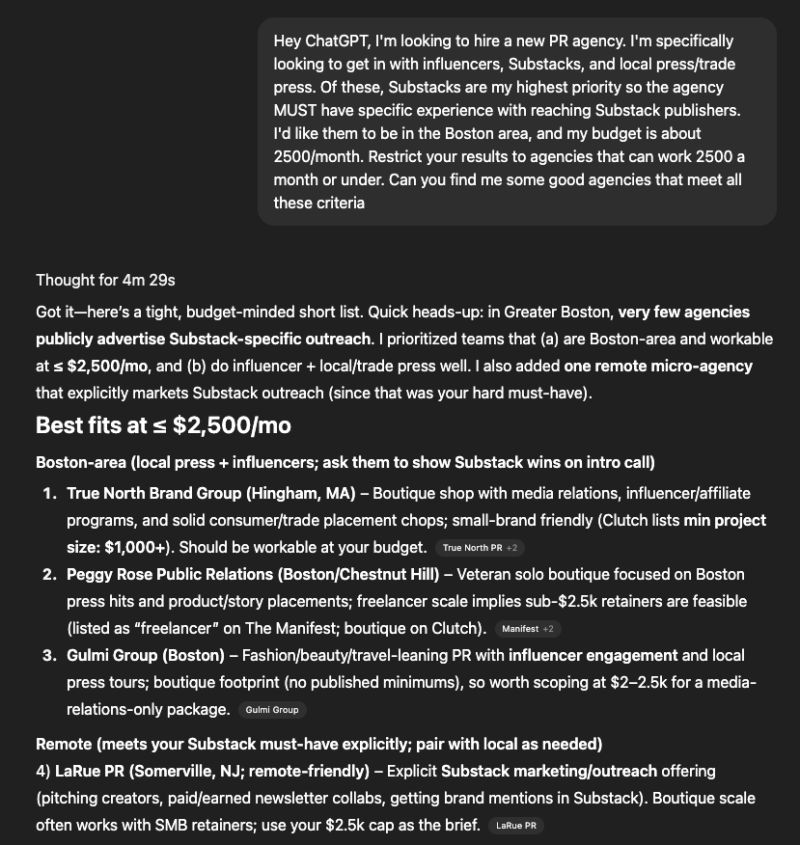
When you withhold pricing information, you plant a seed of distrust. And if people distrust you, they won't buy from you.
What happens when buyers can't find pricing information?
I mentioned it in the introduction: if people are looking for pricing information but can't find it, they will leave your website and look further for a company that is transparent about prices.
The reason for this frustration is simple: buyers know that you, as the provider, know best what your product or service costs (approximately). By deliberately withholding this information, you plant a seed of distrust. And when people distrust you, they don't act and therefore don't buy.
Following the principle of Endless Customers, one of the frameworks we work with at Buzzlytics, it's your responsibility to accommodate your customers and provide the information they ask for. If you don't, they will find that information elsewhere and likely end up with your competitor.
The three most common excuses for hiding prices (and why they don't add up)
"Every project is different."
This is by far the most common reason companies give for not posting pricing information on their websites. “Our services are customized, so we can’t list standard prices.”
However, this argument is easy to refute. You don’t have to list an exact price to still provide valuable pricing information.
Namely, what you can do:
- Explaining what factors increase price
- Explaining what factors lower price
- Explain why some providers are more expensive than others
- Explaining why some providers are so cheap
- Broadly identify where your business is on this spectrum
By sharing this kind of information, you help potential customers understand how value is determined in your industry. You give them the tools to make an informed decision without having to quote an exact price tag.
By being transparent about prices, you help potential customers understand why you're more expensive than others.
"We're more expensive and we don't want to scare people away."
Some companies fear that showing prices will scare away potential customers, especially if they are on the more expensive end of the spectrum.
But what really scares people away is not your price, but that they don't know what your offer costs. They fill it in themselves and then they often think it will be very expensive, much more expensive than it really is.
Plus, by being transparent about prices (and the factors that influence them), you help potential customers understand why you're more expensive than others. You can explain the extra value they get for that higher price.
This has two benefits:
- You attract customers who understand your true value and are willing to pay for it
- You avoid spending time with prospects who would never become your customer
"We don't want competitors to see our prices."
This argument is, in the words of Marcus Sheridan, "utterly ridiculous." Why? Because your competitors probably already have a pretty good idea of what you charge.
Think for a moment: do you have a reasonable idea of what your competitors charge? You probably do. And if you know about them, they know about you.
In reality, this "big secret" is no secret at all. All you achieve by hiding prices is that you make it harder for potential customers to buy from you, while your competitors can still find out if they want to.
The five levels of price transparency
So it's important to be transparent on your website. But how do you go about doing that? There are five levels at which you can be transparent about prices, with Level 0 being the least transparent and Level 4 being the most:
- Level 0: Prices on demand only
- Level 1: Provide information about what sets the price
- Level 2: Pricing videos where you explain what sets the price
- Level 3: Interactive price estimators
- Level 4: Exact price calculators
Below I explain these levels.
Level 0: Bait-and-switch (prices on demand only)
This isn't actually a level of transparency. It's what happens when you have a pricing page that visitors click on expecting to find pricing information, but instead they get a form with: "Please enter your information for a price quote."
This is a classic bait-and-switch tactic that frustrates potential customers. They click on a link for pricing information, but don't get it. Instead, they are forced to contact them.
Some companies defend this approach by saying, "But this works for us! We're getting leads in through this form." What they don't see, however, is how many potential customers they are losing because they don't provide any pricing information. They have no idea how many people leave their Web site again out of frustration.
Level 1: Information about what sets the price
At this level, you offer a pricing page that explains what drives value in your industry. You describe what drives costs up, what drives them down, and provide insight into your industry's pricing structure.
While you may not mention exact prices, you give people a better understanding of how prices work and what they can approximately think about. This is a huge improvement over Level 0.
Visitors appreciate this information. They think, "Ah, that's useful!" And when they subsequently fill out a form, they do so with more confidence because they now have a better idea of what to expect.
Level 2: Pricing videos that explain what affects price
Level 2 takes the information from Level 1 and presents it in video format. This is particularly powerful because "seeing is believing. When people can visually perceive what affects price, they understand it better.
For example, a video can show how different options or configurations affect the price, giving potential customers a much more concrete idea of what to expect.
Level 3: Interactive price estimators
At this level, offer an interactive tool that allows visitors to create their own price estimates. This is a huge step forward in providing value to your visitors.
A good price estimator asks the same questions a salesperson would ask to give a price estimate. Based on the answers, the tool gives a price range or estimate.
This is particularly powerful because it:
- Instantly gives visitors the information they're looking for
- A personalized experience offers
- Allowing potential customers to experiment with different options
- Putting control in the hands of the visitor
Level 4: Exact price calculators
The highest level of price transparency is a price calculator that gives an exact quote. This works especially well for products or services with fixed prices or clear variables.
However, for most companies, a price calculator is either unnecessary or impractical due to the complexity of their offerings. In many cases, Level 3 is sufficient to meet the needs of potential customers.
Most importantly, remember that the first question in the buyer's journey is often "How much does this cost approximately?" while the last question (just before purchase) is "What is the exact price?" Your Web site should answer at least that first question.
"Companies that implement a price estimator on their website and display it properly on the homepage see a 300% increase in leads on average." - Marcus Sheridan
The impact of price transparency on your conversion rate.
300% more leads with price estimators
The benefits of price transparency are not theoretical, they are measurable. According to Marcus Sheridan, companies that implement a price estimator on their website and display it properly on the homepage see an average 300% increase in leads.
This percentage shows how important price transparency is to potential customers. When you give visitors control over when they take in what information and help them answer one of their most important questions, they reward you with their trust and attention.
Why lack of transparency costs leads you never see
Another important point is that if you hide your prices, you never know how many potential customers you will lose. These are the "silent leaks" in your marketing funnel: people who visit your website, can't find pricing information, and leave again without leaving a trace.
Your website statistics tell you how many people visit your pricing page, but they don't tell you how many of them were disappointed by the lack of information. You don't know how many of them went to your competitor who was transparent about prices.
This is why it's so important to look at buyer behavior and not just your own perception of what works. The market is evolving, and buyers expect more and more transparency and control. If you don't adapt to these changing expectations, you risk being left behind.
If you hide your prices, you never know how many potential customers you'll lose.
How to become more price transparent step by step
Start by explaining pricing factors
If you currently have no pricing information at all on your website, the best first step is to create content that explains what affects the price of your product or service.
Write an article or create a page that addresses:
- Factors that increase price
- Factors that drive down price
- Why some providers in your industry are more expensive
- Why some providers are cheaper
- Where your business is on this spectrum
This information gives potential customers a framework for understanding prices and helps them make more informed decisions.
Consider interactive tools like price estimators
If you're ready for the next step, consider implementing an interactive price estimator. This doesn't have to be complicated. The price estimator should simply ask the questions your salespeople would normally ask to provide a price estimate.
A price estimator can:
- Making your website more valuable to visitors
- Improve the quality of your leads
- Save time for your sales team
- Differentiate yourself from competitors who are less transparent
There are several software solutions available that simplify the creation of such tools, such as PriceGuide.ai by Marcus Sheridan.
How to convince your team of the need for price transparency
One of the biggest challenges in implementing price transparency is often internal resistance. Salespeople, management or other stakeholders may have objections to sharing pricing information.
Here are some strategies to persuade your team:
- Share the data: Display studies and statistics that show how buying behavior has changed and why transparency is important.
- Ask the right questions: Ask your team how they feel when they visit a website that doesn't offer pricing information. Make them understand that their buying experience is no different than your customers'.
- Start small: Start with level 1 transparency and show the team the positive results before moving on.
- Focus on the benefits: Emphasize how price transparency leads to better qualified leads and more efficient sales calls because basics like budget have already been covered.
- Share success stories: Show examples of other companies in your industry that have successfully implemented price transparency.
The core of convincing your team lies in showing that price transparency is not about giving away competitive advantage, but about building trust. And trust is ultimately what business is all about.
Companies that take the leap to more price transparency are rewarded with more trust from potential customers, better qualified leads and ultimately higher conversion rates.
Price transparency: from fear to trust and more conversions
Hiding prices on your website may seem like a smart strategy at first glance, but as we've seen, it's often counterproductive. In a world where buyers increasingly want more control over their buying process and do 80% of their research before contacting sales, price transparency is no longer optional, but essential.
Meanwhile, many companies cling to the idea that their situation is unique and that price transparency won't work for them. "Our service is too complex," "We don't want to scare off potential customers," or "We don't want competitors to see our prices" are common arguments. But as we have discussed, these are usually excuses that stem from fear of change, not from an understanding of modern buying behavior.
At Buzzlytics, we've seen time and time again that companies that take the leap to more price transparency - whether it's explaining pricing factors or implementing interactive price estimators - are rewarded with more trust from potential customers, better qualified leads and ultimately higher conversion rates.
The question is not whether you should become more transparent about prices, but how quickly you can make this change. Start analyzing your current approach today.
- What level of price transparency are you currently applying?
- What's the first step you can take to better serve your potential customers?
Whether you choose a comprehensive pricing page, a video explaining the pricing structure or a full price estimator - each step toward greater transparency is a step toward greater trust and better results.
Want to learn more about how to implement price transparency in your specific situation? Then schedule a call with me or one of my colleagues and find out how we can help you transform your website from a source of frustration to a confidence-building sales tool.
Related articles

May 30, 2024
-
Reading time: +/- 8 min

March 27, 2025
-
Reading time: +/- 7 min

June 25, 2024
-
Reading time: +/- 12 min

February 27, 2025
-
Reading time: +/- 7 min